Показаны сообщения с ярлыком buildings. Показать все сообщения

вторник, 23 ноября 2010 г.

Cover from Croatia


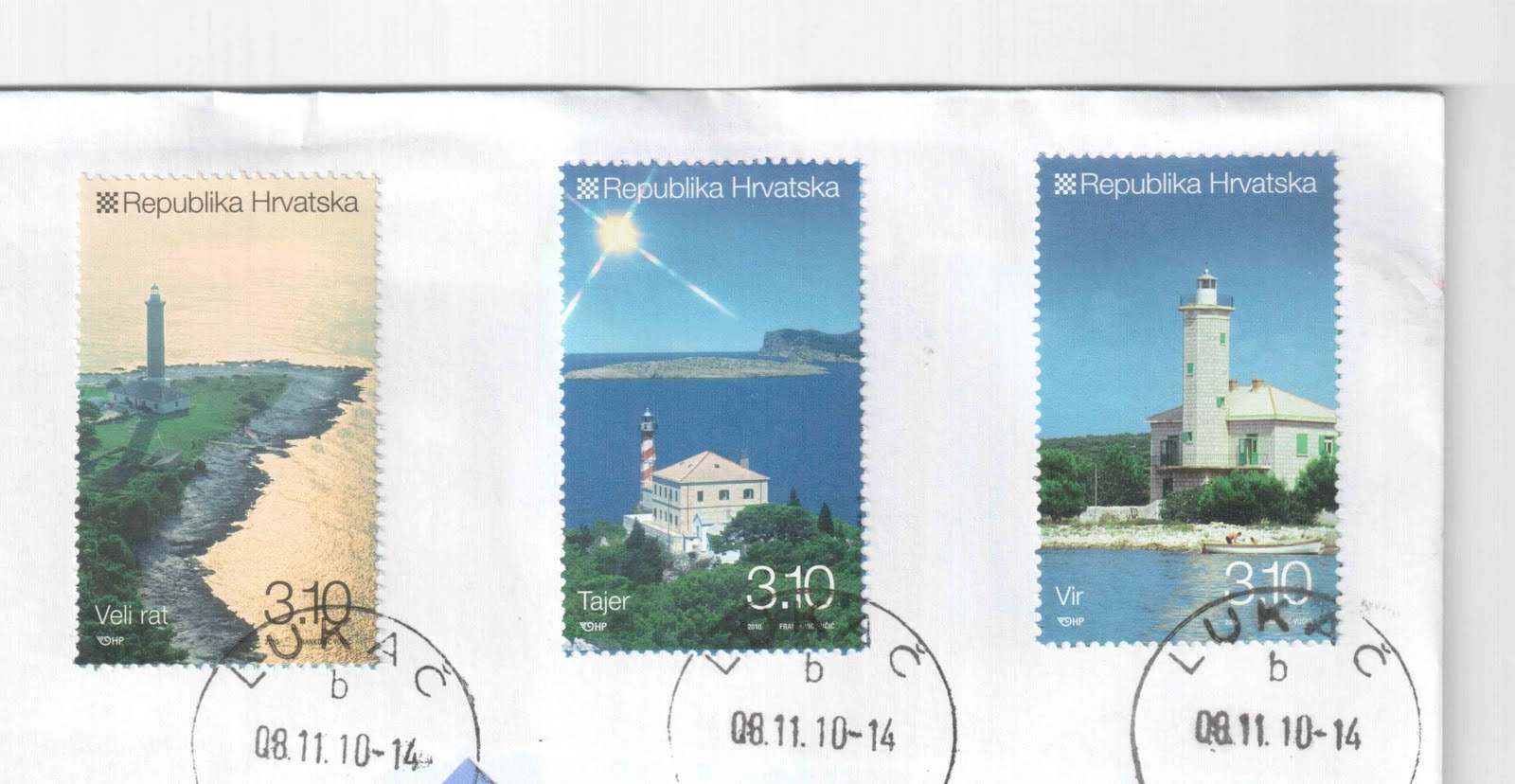
On the 17-th of November after just 9 days of traveling I got another cover from Croatia. This time there is a series devoted to the light houses. Here is the description:


Zagreb, September 7, 2010 – Croatian Post has released today three new commemorative postage stamps from the “Lighthouses” series – Tajer, Vir and Veli rat. The face value of the stamps is HRK 3, 10. The authors of the stamps are Orsat Franković and Ivana Vučić, designers from Zagreb, while the author of the photographs is Andrija Carli, a photographer from Split. The stamps are printed in 100 000 copies per motif, in 10-stamp sheets.

One could say that lighthouses are buildings situated on the coast which aid ships in navigation. But, lighthouses are much more than that. Very few buildings have managed to capture the attention of people from all over the world by their beauty and charm as lighthouses have. Today, lighthouses still serve their purpose, but have at the same time become a favored tourist destination, while many took up photographing lighthouses as a hobby. One of them is Andrija Carli and three of his photographs served as the motif for new postage stamps from the very successful and popular series „Lighthouses“. This year Croatian Post’s stamps depict the lighthouses Tajer, Vir and Veli rat.

The tower of the lighthouse Tajer is connected to the main building by a unique stone bridge, and owing to its distinguishable red and white stripes it has become a tourist symbol of the surrounding archipelago.

The legend of a hidden treasure somewhere near the lighthouse Vir captured the imagination of many treasure seekers. During the 20th century, children of the lighthouse keepers, while playing on the beach, sometimes found gold coins and even a valuable necklace once.

Veli rat is considered to be one of the most beautiful lighthouses in the whole Mediterranean. Besides its beauty, it is also very interesting to tourists because they can rent it out and spend their vacation there, as in many other lighthouses on the Adriatic coast, and enjoy the unique peace and atmosphere a lighthouse has to offer.

Croatian Post has to date issued twelve stamps altogether in the “Lighthouses” series, started in 2007, and the interest for them has been growing ever since.


Another stamp with the beautiful ethnic tracery represents CROATIAN ETHNOGRAPHIC HERITAGE - Međimurje.

Thank you very much, Josip!


Cover from Bosnia and Hercegovina


On the 8-th of November I got my first cover from the ex-Yugoslavian republic - Bosnia and Herzegovina. Unfortunately, I couldn't find any information about the stamps, because at first I'm not sure if they are Bosnian since it's written on Cyrillic and says that it's Republica Serpska and the Serbian Post web page is unavailable. But as far as I understood, the first stamp on the lefet is devoted to the contemporary Serbian art, it's a picture "Zebil'eeva street" by B. Shoshra. the other stamp represents the Grachanitsa monastery in Serbia.


Thank you very much, Nebojsa! 


понедельник, 11 октября 2010 г.

Cover from Croatia


On the 10-th of June after 34 days of traveling I got this cover from Croatia. The stamps are devoted to the anniversaries of several things such as: 1) Franciscan church 2)FRANCISCAN ORDER 3) St. MARTIN’S HERMIT CHAPEL.

You can find more information about this events on the official page of the Croatian post. The page is just amazing - it provides us a lot information on the tamps! Here it is:

350 YEARS OF FRANCISCAN PRESENCE IN ČAKOVEC 

800TH ANNIVERSARY OF THE FRANCISCAN ORDER

800TH ANNIVERSARY OF St. MARTIN’S HERMIT CHAPEL IN PODSUSED


Thank you very much, Josip!

вторник, 3 марта 2009 г.

Cover from Italy


I got this cover on the 22-nd of February after 13 days of travelling.  It's devoted to the World Stamp Exhibition which took place in Rome in 1985. You can also see nice barocco style buildings on it. Thank you, Lamberto! 

Сover from Romania


Nuclearelectrica is an active member of the specialized international organizations, as WANO-Atlanta Center (World Association of Nuclear Operators), COG (The CANDU Owners Group), World Nuclear Association (WNA) as well as Electric Power Research Institute (EPRI).
The Company has developed efficient long time partnerships inside the AIEAEuropean programs of regional cooperation and it is also a member of FORATOM Group.
Today the science people and the economic and industrial agents from all over the world are concerned to contribute to solving – in the best interest of each nation and also of the entire humanity – the problem of safety guarantee in power supplying, with a minimum impact on the environment and with a low cost.
Considering this world context, the nuclear energy prefigures to be an essential element of the energetic mix which will guarantee the present and future demands of the humanity for power.

The art of pottery is one of the oldest in the world.
Even since ancient times, it has epitomized all the things related to the spiritual life.
Along the years, the art of pottery has developed itself in the societies which had a sacred image of the world and has been transmitted from generation to generation for thousands of years.
In Romania, the art of pottery dates from around VI millenium B.C.
Through their shape, size, decorative designs and chromatics, the pitchers express the potter´s technical resourcefulness and their inspiration, as they have adjusted the Greek-Roman influences and, later on, those of the migratory populations, maintaining nevertheless the specific features of the Romanian cultural space.
The used symbols are the solar ones, as the head of the ram or the winged horse, while the snake is portrayed as a spiral, this shape being the symbol of cosmical positive evolution.
The pots have accompanied the human communities along the milleniums and they have always been part of all the spiritual manifestations specific to the Romanian people.
Pottery represents, on the whole, through its shapes and symbols, an openning and a spiritual invitation towards the mystical spheres of the ancestral culture.
The stamp with face value of RON 0.30 represents ceramics items from Leheceni, Bihor.

On the 27-th of February after 9 days of travelling I recieved this cover on the envelope with a card via postcrossing project. I found very informative and nice descriptions of the stamps on romanian philatelic site.